Showing posts with label sustainability. Show all posts
Friday, October 28, 2016
What Constitutes a Good Life?
I've been thinking about what it takes to live a good life in retirement. My husband is considering his options for after he reaches retirement age and has been concerned about whether or not we will have enough income. It doesn't help to see all the guidance that claims one will need enormous amounts of money in retirement accounts and that Social Security won't be enough.
My concerns about the environment, too, led me to look at My Make Do and Mend Life, again. One of the comments on her October 13th blog entry led me to Shannon Hayes' writings. In her book, A Homespun Mom Comes Unraveled, she talks about people using their purchases to "vote for the kind of planet and society they wanted to be part of." She also discusses what she calls "radical investing," which really speaks to my issues with the idea that one needs to have a large income in order to live a happy life. For us, that means that we have reduced our cost of living by eliminating our debt, purchase only what we really need, and that we take care of what we have. We have also set aside an emergency fund to cover unexpected expenses, regularly add to savings (including a dedicated fund for property taxes and house insurance), keep track of where we spend our money, budget for regular expenses (including "mad money" we can spend as we wish), and we try to make gifts and some of the things we might want.
While we do have my pension, which was built up by an 8% contribution from my income and a matching amount from my employer, since I worked for a public university, my Social Security income will be reduced, even though I paid into the system there in other jobs. There is a movement to have that law changed, but I don't feel I can count on it happening. (The law was set up to prevent public employees from "double dipping," even though people who work for corporations can have the same type of set up for pensions through their employers and get the full amount of Social Security for time they paid into the system.)
Beyond the pension and Social Security income, we have a small amount in annuities, which will provide additional funds, and we have medical insurance coverage. Altogether, however, our totals are well below what the "experts" say is necessary. Given the fact that we have been tracking expenses, I have calculated we will be fine, even though that is the case.
We will continue to vote for a planet and society that cares for the earth and other people, as well as ourselves. As with the choices we made that enabled us to create a certified wildlife habitat with our suburban property, we consciously decide what is most important to us. That does include the idea of downsizing in retirement, as well as continuing the practices that have allowed us to live well on considerably less per year than the experts see as necessary.
What do you think? How do you vote with your purchases?
Until next time, I wish you peace.
(Note: I provide links to you only as a convenience, and the inclusion of any link does not imply affiliation by me with any site.)
Friday, January 22, 2016
Making a Difference
The wild weather we have been experiencing around the world has me
thinking about climate change and ways we can do something about it. I've come
across some very interesting articles recently that illustrate possibilities.
The following is from Meg
Niederhofer: Celebrating Gainesville's passion for trees:
Most urban trees grow yards; they belong to
individuals, but we all benefit from them. Rain falling onto branches and
leaves is dispersed, meaning gradual absorption into the soil as opposed to
sheeting over the ground that causes erosion and flooding.
Likewise the sun’s rays are intercepted
(shade), foliage absorbs air pollutants, and beneficial root fungi take up
phosphorus and heavy metals that would otherwise pollute ground water. During
major storm events Gainesville’s abundant tree canopy intercepts the winds,
deflecting damaging force away from homes.
Home
Sweet Home by Carolyn Pearce - this has sparked some ideas for pieces
focusing on places and peoples that have not received a lot of attention in the
artistic community nor the media.
Making Do .
. . - reminded me of the times I sat with my grandmother while she
darned socks or sewed on buttons.
And then, there was this from a book I've been reading:
[O]ld quilts made from recycled fabrics
reminded Japanese needlewomen of the past, of the days when their mothers
patched clothing or made household items from scraps. It didn't matter that
these quilts had tears or worn patches in them, this was part of their charm.
We Japanese have traditionally cherished old fabrics, and the idea of creating
something artistic and useful from scraps appealed to our ideal of beauty. (Japanese
Quilts by Jill Liddell & Yuko Watanabe (c) 1988, p ix)
It ties in, of course, to using recycled, found, and vintage materials in my work.
What do you think? Is there something you would like to suggest to others?
Until next time, I wish you peace.
(Note: I provide links
to you only as a convenience, and the inclusion of any link does not imply
affiliation by me with any site.)
Friday, January 8, 2016
Goal Setting and Other Thoughts - Part Two
Knit ear warmer
As soon, it seems, as Christmas was over, I found myself excitedly working on my year-end inventory and goals. Still, it took a while to be able to work through everything, which is why I have been so quiet here.
I used a slightly different method this year. Before I got started, I had written a list of things I felt I should consider as I determined my goals for 2016, letting it simmer in the back of my mind for a few weeks. When I finally sat down to work on the inventory and goals, I listed the things I had accomplished in 2015 and wrote down everything I thought I might want to do in 2016. One of the books I had been reading about goal setting suggested creating a "pie" with wedges indicating areas of your life that you want to focus on. The categories I arrived at were: Financial, Health & Exercise, Creativity, House/Housing, Intellectual Stimulation, and Family & Friends. My next step was to divide everything I want to do into those categories. Then, I cut them down to a maximum of five items per category. (I may need to reduce that further, however.)
After working with those items for about a week, I realized that I needed to be more specific in a few of them. In particular, I needed to decide how to implement the Creativity goals with a focus on the business. As I mentioned back in September, I decided that I could create for myself. What that means to me is that I am free to experiment with techniques and styles without as much concern about the marketplace. In keeping with my concerns about our world and its future, I returned to the idea of incorporating the concepts of simplicity, functionality, and beauty into my work. In addition, my goal, as always, is to use recycled, found, and vintage materials where possible, expressing the concepts of global equity and sustainability.
Finally, while I am very pleased with the things I managed to create in 2015, like the ear warmer (which was a big hit!), I was disappointed in how few there were. In addressing the issue, I began to come to terms with the difficulties I have in sticking to my schedule when people around me request my time. After coming up with a more definitive schedule, I made some decisions about how to handle those requests. Only time will tell if I have finally come up with the answer, but I am hopeful that 2016 will prove to be a much more productive and satisfying year.
Monday, November 30, 2015
Finally Normal
These pictures were taken during the snow storm we had November 21st. We got about half a foot of snow. It was all gone within three days, and temperatures hit their normal range for our area at this time of year. (They had been running above normal.) Thinking about that and the United Nations Climate Summit led me to this interesting article. What's the difference between global warming and climate change? There is a lot more information on the website about the various situations and questions relating to issues involved.
Global warming, by the way,
refers to the overall temperature of the planet. It is not meant to indicate
temperatures in specific locations.
Today marked the beginning of the
summit. The agenda is an ambitious one, but very necessary. You can find out
more at UN
Climate Change Conference. I hope you will check it out.
Until next time, I wish you
peace.
(Note: I provide links
to you only as a convenience, and the inclusion of any link does not imply
affiliation by me with any site.)
Friday, July 24, 2015
Looking to the Future
According to the National Association of Home Builders (Housing Facts, Figures, and Trends for March 2006) the average square-footage of a single family home in the U.S. increased from 983 sq. ft. in 1950 to 2,349 sq. ft. in 2004. In my research for my master's thesis (on Sustainability), in 2002, I found that in 1940 the average was 750 sq. ft. By 1970, the average was only 1500 sq. ft., so the Baby Boomer generation grew up in homes that averaged between 750 and 1500 sq. ft.
According to Emma Johnson, (Forbes The Real Cost of Your Shopping Habits), "In 1930, the average American woman owned nine outfits. Today, that figure is 30 outfits — one for every day of the month."
Obviously, I am thinking about these things, in part, because of the issue that I mentioned last time I posted - downsizing. However, it is also due to the greater issue of our impact on the earth. In yesterday's news, there was a report of the finding of a possible second "earth," that may have life on it. This is the first time anything like it has been located in our space exploration, and it is 1400 light years away. (In other words, if we could travel at the speed of light, it would take 1400 years to reach it.) Yet, I heard, to my horror, a newscaster suggest we might be able to move there when we can no longer live here. My belief is that we need, instead, to figure out how we can live on the planet we have.
The other night, PBS aired a program called Humanity from Space. It chronicles the development of man, the technologies that have changed the world and how we interact with one another, and explores our potential challenges to survival.
All of this took me back to the message of Pope Francis about limiting our needs that I mentioned in my post Living in Harmony. We would solve a lot of our problems with that simple prescription. One of the current advocates of this lifestyle is Joshua Becker, who has a blog called "Becoming Minimalist." His self-identified Most Popular Posts are a good place to start in determining how to go about doing so and why.
I hope that you will explore these ideas and see how they would impact your life.
Until next time, wishing you peace and all good.
(Note: I provide links to you only as a convenience, and the inclusion of any link does not imply affiliation by me with any site.)
Saturday, July 11, 2015
Thinking of Space
Last week there was a segment on the news about the buying patterns of new home buyers that suggested people are going back to the pattern prominent prior to the recession. That is, the report said people are buying homes that are quite large. When I looked at the information available on the Census website Characteristics of New Housing - 2014, I found that the average size of new single-family homes has been increasing without any apparent impact from the recession. The site gives the average square footage of homes from 1978 through 2014. Over that time, they increased from 1650 to 2506 square feet.
As someone who grew up in a house that was approximately 2500 - 2900 square feet with ten people around the dining room table every night, I can attest to the fact that one can live comfortably in 250 to 300 square feet per person. I never felt I could not find a place to be alone if I wanted it nor did I feel lonely if I wanted to be with people.
Part of the reason I have been thinking so much about this has to do with my intention of downsizing in the next few years. Another is my sense that we, as a country, need to think about our use of energy and materials. Someone pointed out to me recently that "Mother Earth" will be fine no matter what we humans do about climate change, but we humans won't be so lucky. Along the way, we are also taking other species with us.
There is another movement in the country, and apparently, around the world, towards building homes that are minimal. According to many of the people in the Small_house_movement, tiny-house-nation: the-tiny-house-movement, Tiny House Talk and Tiny House Community, tiny houses are 400 square feet or smaller. The majority of these appear to be movable, since many communities have restrictions on house size. Many of the articles I have seen on these homes indicate that the exterior views play a large part in making the homes feel comfortable, while the inhabitants have also scaled down the majority of their possessions to fit the space.
While I cannot see myself moving into a "tiny house," in part because I anticipate moving as a couple and also because I do entertain my family several times a year, I can see the logic in downsizing to a space that is significantly smaller than the 1760 square feet we now occupy. It will require rethinking what I actually need to have available to me and how much space to allow for every activity.
How much space do you feel you need? Why?
Until next time, I wish you peace.
Saturday, June 27, 2015
Living in Harmony
My break from the studio was punctuated by a flurry of activity in visiting, and our granddaughter providing a reminder that she had been here:
We got the chance to have several days together, sharing meals, stories, reconnecting with old friends, and getting lots of hugs. After they left, I was able to return to the studio and begin working, again, on the quilt. Some of the pieces are now up on the design wall:
Last week, the Vatican released Pope Francis's latest encyclical: Laudato Si: On Care of Our Common Home. While it is a long document, it is worth taking time to read. In it, he addresses the impacts of continued disregard of the evidence of climate change, as well as suggesting how one can make a difference. Since he considers not only lifestyle changes but political and community actions, it presents a variety of ways one can influence the state of the entire world for years to come.
I found several sections especially interesting. For example, on lifestyle changes:
The press conference at which the encyclical was launched produced a document that is also worth looking at. Vatican Press Conference - Presentation of "Laudato Si - On Care of Our Common Home" -June 18, 2015. (To read it in English, one needs to scroll down.) I found the section on the science extremely informative.
My own preferences for action tend towards lifestyle changes and spreading the word to others. In that light, I wanted to suggest a few other sites to check out. These businesses present a variety of ways in which materials can be fully used and ways to provide jobs and income.
Reuseworks is a non-profit that conducts worker training and uses waste and discarded materials for its products.
Rpreservedcom is a business providing upcycled and vintage items.
The Knittin' Kitten is a shop in Portland, Oregon that buys previously owned but not used craft supplies from estates and people who are downsizing and sells them both in their shop and on Etsy. They also create some art and craft pieces for sale.
I am sure that there must be a variety of other businesses and community activities addressing these ideas. I invite you to add any of which you are aware to the comments.
We got the chance to have several days together, sharing meals, stories, reconnecting with old friends, and getting lots of hugs. After they left, I was able to return to the studio and begin working, again, on the quilt. Some of the pieces are now up on the design wall:
Last week, the Vatican released Pope Francis's latest encyclical: Laudato Si: On Care of Our Common Home. While it is a long document, it is worth taking time to read. In it, he addresses the impacts of continued disregard of the evidence of climate change, as well as suggesting how one can make a difference. Since he considers not only lifestyle changes but political and community actions, it presents a variety of ways one can influence the state of the entire world for years to come.
I found several sections especially interesting. For example, on lifestyle changes:
“211.
. . . . A person who could afford to spend and consume more but regularly uses
less heating and wears warmer clothes, shows the kind of convictions and
attitudes which help to protect the environment. There is a nobility in the
duty to care for creation through little daily actions, and it is wonderful how
education can bring about real changes in lifestyle. Education in environmental
responsibility can encourage ways of acting which directly and significantly
affect the world around us, such as avoiding the use of plastic and paper,
reducing water consumption, separating refuse, cooking only what can reasonably
be consumed, showing care for other living beings, using public transport or
car-pooling, planting trees, turning off unnecessary lights, or any number of
other practices. All of these reflect a generous and worthy creativity which
brings out the best in human beings. Reusing something instead of immediately discarding
it, when done for the right reasons, can be an act of love which expresses our
own dignity.”
“212.
We must not think that these efforts are not going to change the world. They
benefit society, often unbeknown to us, for they call forth a goodness which,
albeit unseen, inevitably tends to spread. Furthermore, such actions can
restore our sense of self-esteem; they can enable us to live more fully and to
feel that life on earth is worthwhile.”
As well as:
“222. Christian spirituality proposes an
alternative understanding of the quality of life, and encourages a prophetic
and contemplative lifestyle, one capable of deep enjoyment free of the obsession
with consumption. We need to take up an ancient lesson, found in different
religious traditions and also in the Bible. It is the conviction that “less is
more”. A constant flood of new consumer goods can baffle the heart and prevent
us from cherishing each thing and each moment. To be serenely present to each
reality, however small it may be, opens us to much greater horizons of understanding
and personal fulfilment. Christian spirituality proposes a growth marked by
moderation and the capacity to be happy with little. It is a return to that
simplicity which allows us to stop and appreciate the small things, to be
grateful for the opportunities which life affords us, to be spiritually
detached from what we possess, and not to succumb to sadness for what we lack.
This implies avoiding the dynamic of dominion and the mere accumulation of
pleasures.
“223.
Such sobriety, when lived freely and consciously, is liberating. It is not a
lesser life or one lived with less intensity. On the contrary, it is a way of
living life to the full. In reality, those who enjoy more and live better each
moment are those who have given up dipping here and there, always on the
look-out for what they do not have. They experience what it means to appreciate
each person and each thing, learning familiarity with the simplest things and
how to enjoy them. So they are able to shed unsatisfied needs, reducing their
obsessiveness and weariness. Even living on little, they can live a lot, above
all when they cultivate other pleasures and find satisfaction in fraternal encounters,
in service, in developing their gifts, in music and art, in contact with
nature, in prayer. Happiness means knowing how to limit some needs which only
diminish us, and being open to the many different possibilities which life can
offer.”
And on community work vs. political action:
“232. Not everyone is
called to engage directly in political life. Society is also enriched by a
countless array of organizations which work to promote
the common good and to defend the environment, whether natural or urban. Some,
for example, show concern for a public place (a building, a fountain, an
abandoned monument, a landscape, a square), and strive to protect, restore,
improve or beautify it as something belonging to everyone. Around these
community actions, relationships develop or are recovered and a new social
fabric emerges. Thus, a community can break out of the indifference induced by
consumerism.”
The press conference at which the encyclical was launched produced a document that is also worth looking at. Vatican Press Conference - Presentation of "Laudato Si - On Care of Our Common Home" -June 18, 2015. (To read it in English, one needs to scroll down.) I found the section on the science extremely informative.
My own preferences for action tend towards lifestyle changes and spreading the word to others. In that light, I wanted to suggest a few other sites to check out. These businesses present a variety of ways in which materials can be fully used and ways to provide jobs and income.
Reuseworks is a non-profit that conducts worker training and uses waste and discarded materials for its products.
Rpreservedcom is a business providing upcycled and vintage items.
The Knittin' Kitten is a shop in Portland, Oregon that buys previously owned but not used craft supplies from estates and people who are downsizing and sells them both in their shop and on Etsy. They also create some art and craft pieces for sale.
I am sure that there must be a variety of other businesses and community activities addressing these ideas. I invite you to add any of which you are aware to the comments.
Friday, May 15, 2015
Spring Activities
The last couple of weeks have been very full. One of the things I took time out to do, however, was to watch the documentary Chasing Ice. James Balog, an award winning photographer, and his team filmed what happened to glaciers in the northern hemisphere from 2005 to about 2008 or 2009. You can find more information about it at the link above and on the Chasing Ice Facebook Page. It is an incredible film with stunning photography. They have been doing the same thing in the southern hemisphere since 2012.
I also had the opportunity to photograph some unusual visitors to my landscape.
Baltimore Orioles
I apologize for the blurriness of this one, but we were also visited by
A Rose-breasted Grosbeak
These visits are, of course, signs that the weather is turning warmer, though it hasn't felt quite like that recently around here. The vegetation has also made it clear, though it went through the flowering stage very quickly. We have, so far, avoided severe weather. Unfortunately, other areas of the country have not been so lucky. Between heat and storms, it has been a tumultuous spring.
Another thing I've been considering lately is our garden. I would love to be able to plant more and my hubby appears willing to do a lot of the work (since we're not sure how my allergies will react). I decided to check out this article: Planting your spring garden? Consider climate’s ‘new normal’ (You have to scroll down to the specific link.) As the article states:
"Climate normals can help people understand what conditions they can expect wherever they may live… and plant. A previous article on Climate.gov explored the implications of the new climate normals for gardeners and landscapers. Not only can plants can generally survive farther north than they used to, but the fire season is longer and pests are able to thrive and spread in forests and other natural landscapes. Pollination patterns may also be changing."
For me, this is yet another reason to pay attention to the impact of our activities on the world around us. I hope that you will, too.
Until next time, I wish you peace and all good.
Labels:
birds,
environment,
garden,
sustainability,
weather
Saturday, March 7, 2015
Artist's Voice
A couple of my friends recently moved,
downsizing in the process, which reminded me of my need to declutter and reduce
my possessions. My hope is that, when my husband retires, we will be able to
downsize, too, but right now we have too much stuff for a smaller house. In
light of that, I was intrigued by a method I saw demonstrated recently and the
book written by its inventor: Marie
Kondo: The Life-Changing Magic of Tidying Up. While I don't
agree with some of her recommendations, I do believe her method of sorting
through one's possessions warrants a try. So, I borrowed her book from the
library and plan to attempt the process. (Thankfully, she states that doing it
"quickly means about half a year.")
As part of my work on getting ready to set up a
shop, I have also been thinking about what success looks like to me. I finally
came to the conclusion that it encompasses three things: creativity, a flexible
schedule, and supplemental income. Since I have health issues that are
exacerbated by stress, it is crucial that I maintain a calm atmosphere and not
try to do too much. To that end, I realized that I need to limit my work on the
business to part-time. While that means I cannot do as much, it also means I
have time to explore other interests and be available to my family as needed.
(For example, I am also doing research for a book I want to write.)
I also recently purchased a copy of The Worldwide History of Dress as a
reference book for clothing styles throughout the world. While it does not have
quite as many examples of contemporary clothing as I had hoped, it gives
details about many cultures that I know little to nothing about. For that
reason, it is probably even more critical to my work, since I want my artwork
to incorporate a global vision. Incorporating that vision is part of my
artistic voice. Leni Levinson Wiener had an insightful post on weallsew.com this week about the artist's
voice and how to find it. Though I have been creating for a lot of years, I
have only just begun that work.
What I do know is that I want to highlight the
similarities between people around the world and my belief that we need to
think more about how our actions impact everything on this planet we call home.
That is part of the reason I want to downsize. I believe we use more of the planet's
resources than is healthy for the planet and that people in many other
countries aren't able to use enough, both for their own comfort and the health
of the planet. It is also part of the reason I am a proponent of simple living.
I am looking forward to enjoying the simple
pleasures of spring.
I wish you simple pleasures.
Peace.
Friday, October 17, 2014
Finding Direction
As some of you will know, if you have been following my blog, I have been searching for a clearer direction for my work for some time. All of the research and introspection I have been doing has, finally, born fruit. In addition to making a decision about the types of products I will offer and the use of primarily re/upcycled and/or vintage materials, I have narrowed down my design focus to the environment and endangered species. It has been a long process to get to this point, but I expect making the decision will free me to be more prolific.
I have, finally, been able to get another of the pieces I had been working on finished. Decisions about the quilting kept holding me up.
Until next time, I wish you peace and all good.
Thursday, August 14, 2014
World House
I know I’ve been quiet for an awfully long time. It seems I
really needed to take a break from the blog to do a little . . .
Check out the flowers . . .
In addition, I have returned to something else I’ve been
putting off for a long time.
Many years ago, when I was selling my crafts at local shows,
one of my sisters asked me if I would collaborate with her in creating 1/12
scale dolls. The scale refers to a size that equates to 1” = 1’. Though I was
nervous about my ability to make clothing for such small dolls, I agreed to
try. She would create the dolls from porcelain. So began my introduction to the
world of miniatures.
About the same time, I was reading a book by Peter Menzel
called Material World. He went on to do another called Woman in the
Material World with Faith d’Alusio, which I also read. The books show the
real life situations of up to 30 statistically average families from various
countries around the world. You can find out more about it here: http://www.menzelphoto.com/books/mw.php.
Also about that time, I came across statistics for a world
portrait, if the earth were populated by 1000 people. That, in turn, combined
with the miniatures and Material World information led me to design a
1/12 scale house I call the “World House.” (Since then, the statistics have
been updated several times. The current ones, for a world population of 100 people
can be found here: http://www.100people.org/statistics_100stats.php?section=statistics.
) While the statistics have changed slightly, they are similar enough that my design
still works.
In the house, I have a Chinese grandmother, Hispanic mother,
African father, Bhutanese teenaged son, Italian child daughter, and an Indian
baby boy. This is my solution for the problem of how to people the house in a
way that models the ethnic and cultural population of the world. The “people”
also conform to other details of the statistics, such as religion and
education. While the house is an American dollhouse and I am still working on
it, it has space apportioned according to the real world situations, material
goods for each “person” as they would have in their respective countries, and the
“people” have occupations similar to their counterparts.
In the intervening years, I have not had much time to work
on the house, as other things have taken precedence. However, I recently began
going through my materials, and then, got information about the upcoming Chicago
Miniatures Show, both of which reignited my drive to continue. Many of the
pieces I use or plan to use are made with recycled materials, giving me another
way to conserve resources and avoid having things end up in a landfill.
Have you ever thought about what the whole world looks like
in terms of human population or wondered what life was like for someone in a
different country? What would your choices be if you were designing a World
House?
Until next time, as always, I wish you peace and all good.
Saturday, February 22, 2014
Simple Living
I have been thinking about simple living, especially in
the contexts of minimal impact on the environment and slowing down in our fast-paced
world. All kinds of things have contributed to this process, such as: Jude Hill’s
blog, Maya Donenfeld, my concerns about the environment in the midst of this strange winter, Kimberly
Palmer’s new book The Economy of You, “Frontier House,” the amount of
time spent indoors due to the weather and illness, and my attempts to discern
next steps.
I’ve been reminded recently of our search for a house
when we moved to our current location. According to the realtor (and the bank),
we could have afforded more in a mortgage than we were comfortable undertaking.
In the almost 25 years that we have lived here, our decision to buy a smaller
house and live with a lower mortgage has proven to be a wise one. We have had
lots of expenses that would have been impossible to cover otherwise, including
college costs for three children and ourselves.
My husband went back to school
to complete his degree after being downsized. I was already in school
completing mine at the time. Thankfully, I was able to get a full-time job at
the university I attended, which allowed us to cover our expenses for the time
it took my husband to finish his degree and find a job, me to finish both my BA
and MA, and one of our sons to attend college. We had a picture window to
replace when a son’s stone-skimming attempt turned into a fractured window.
There
was the lower-level flooding that required new flooring, cabinetry in the
utility room and a bath, and new drywall; the spring storm that required a new
roof and air conditioning unit and led to replacing the furnace, too; and a
multitude of other expenses we couldn’t have foreseen, as well as the normal
expenses inherent in raising three children.
It is apparent that, in many ways, we have lived more
simply than many in our society. Simultaneously, we live with a lot more than many,
both in our country and around the world. At one point in my life, I was
feeling somewhat deprived because I was comparing what I had to others in my
circle who had larger houses, fancier cars, and other luxuries that I did not.
When I made the conscious decision to compare my life and possessions to
another friend whose home was about half the size of mine, I felt rich. I
realized, then, that much of the discontentment in our society stems from the
idea that we are entitled to the absolute best rather than a search for what
makes us feel good about our lives.
While we appear to have practiced simple living more than
many people, I have been encouraged by the number of people who appear to have
embraced the idea recently. In addition, I have been trying to do even more.
One of the things I have been doing is imitating my mother, who used to give
things away when their usefulness to our family was over. Another is to follow
the admonition, made popular during the Great Depression and WWII of “Use it
up. Wear it out. Make it do or do without,” which my grandmother used to repeat
often. I try to make many, if not most, gifts. Additionally, when I do need to
purchase something, I try to see if I can get it used or can make it with
materials on hand. I anticipate downsizing our home in the next few years, too.
I am curious about whether you have considered the idea
and, if so, what steps you have taken toward that goal? How do you feel about
it?
Sunday, February 9, 2014
Reclaiming Leftovers
One of the things I am committed to is striving to keep as
much as possible from going to waste and ending up in landfills. We reduce our
use of many things; compost as much as possible; reuse paper, plastics,
aluminum, etc.; recycle everything our local system accepts; donate reusable items; and try to reclaim
anything that can be used in new ways.
Since I often work on projects that require coordinated fabrics, I tend to forget about all the bits and “crumbs” available to me. While I’ve considered techniques like Noriko’s in the past, I haven’t done much with them. These videos seem to be a wake-up call to think about them in different ways.
How about you? Do you have additional ways of using up those
pieces? If not, do the examples spur any new ideas? I'd love to hear how you would use some of your scraps to create new works of art.
Until next time, I wish you peace and all good.
Like Christmas cards
Bubble wrap
Magazines & wallpaper
Recently, Ami Simms posted a blog entry challenging people
to use leftover fabric. The 2014 Crumb Quilt Challenge
It included a video from one of her classes. It was about
how one of the students uses the leftover pieces from quilt blocks. Crumb Quilts
About the same time, I happened to see a video of Noriko
Endo on The Quilt Show with Alex Anderson & Ricky Tims describing how she
creates her pieces with what she calls “confetti.“ There are two videos available
onYouTube: Confetti1 and Confetti2
I started thinking about using up the fabric scraps I have been accumulating over the years.
Since I often work on projects that require coordinated fabrics, I tend to forget about all the bits and “crumbs” available to me. While I’ve considered techniques like Noriko’s in the past, I haven’t done much with them. These videos seem to be a wake-up call to think about them in different ways.
Until next time, I wish you peace and all good.
Sunday, May 5, 2013
Book Review
I recently read an interesting new book called Overheated: The
Human Costs of Climate Change by Andrew Guzman ©2013 (Oxford University Press).
I have no stake in the book, financial or otherwise, but feel it is important
enough to be worth writing about.
Rather than describe the science, Guzman looks at the results that would occur (and in some cases are already happening) if a conservative estimate of global warming proves true. He uses analogies throughout the book that are quite effective in describing a variety of the basic issues. In addition, he provides clear examples of the various scenarios that are possible. Guzman also gives an account of the support for claims on both sides of the issue so that the average person has a better understanding of who is on each side. One point that he makes is an answer to those who feel we should wait to respond or that there is significant time to make changes. His response is to question whether the person is saving for a child’s college education or for retirement because many of the changes that are projected will likely occur within the next two to thirty-five years.
While I would have
liked to have seen more prescriptions for ways in which individuals can impact
the situation, Guzman keeps the book short enough to be readable while covering
a significant amount of material.
I heartily recommend
reading the book whatever side of the issue you are on. While he certainly
takes the position that the climate is changing, the ramifications in terms of
its impact are spelled out clearly and may surprise you.
As always, I wish you
peace and all good.
Tuesday, March 19, 2013
Reorganized Studio
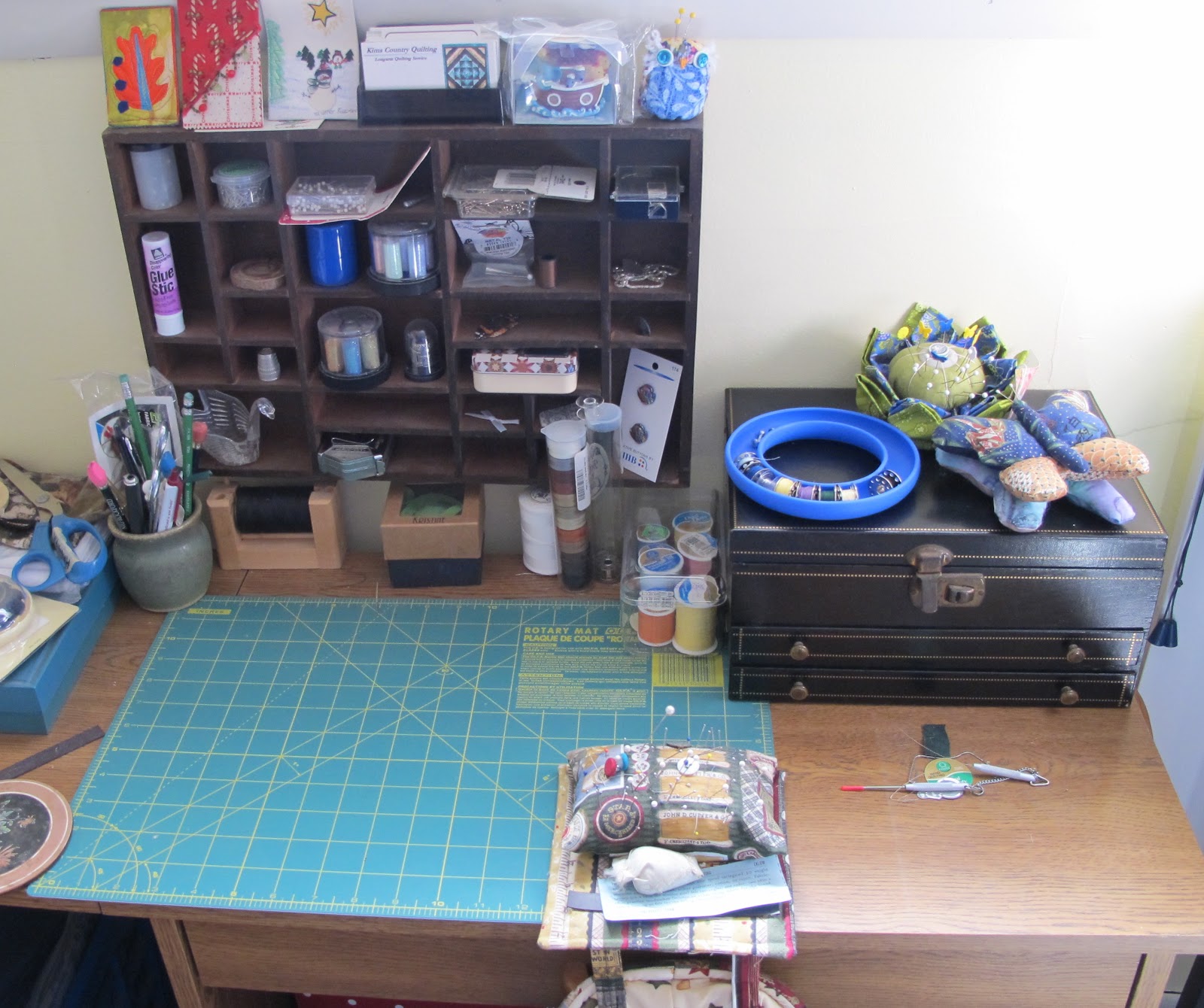
The last six weeks have been busy as, in addition to making the baby quilt I showed you in the last post, I have been working on reorganizing the studio. I resolved the question of fat quarter storage with paper covered boxes and Terry Atkinson's folding method shown on Sewing with Nancy. I'm quite pleased with the result. Thanks to all who offered suggestions.
Since that side of the room needed to be reorganized, a few changes also had to occur elsewhere. I cleared one of my worktables to use for working on dolls and other small projects . . .
Obviously, there is still tweaking to be done, but the studio is much more work friendly. My supplies are all organized; I have a much better idea of what I have available; and I'm loving the expansion to the floor space, since it is a small room. I did end up keeping some bins, but they now hold WIPs (Works in Progress) and specialty fabrics (primarily recycled pieces).
One of the things that all this reorganization reminded me of was the post I wrote on Hopes vs. Goals last year. While there are still things I feel I haven't made enough progress on, I did complete or make progress on quite a few. That, in turn, made it clear that making that kind of a list is a great help, not only in identifying what one wants to concentrate on in a given period, but also as a check in the future to identify how close one has come to one's hopes.
I find that I have also been inspired by the work of one of my friends. She has been working on building up a business over the last few years. She created the little box on the left of the bookcases.
You can find more of her work at Cross Stitch Treasures by CanvasFun. She has a wonderful eye for design and some interesting ideas. I hope you will check out her shop.
Until next time, I hope you will make progress on your hopes and that you enjoy peace and all good.
Since that side of the room needed to be reorganized, a few changes also had to occur elsewhere. I cleared one of my worktables to use for working on dolls and other small projects . . .
I also added a rolling cart for doll-making supplies which meant I had to move the file cabinet and beading supplies next to the sewing table . . .
Obviously, there is still tweaking to be done, but the studio is much more work friendly. My supplies are all organized; I have a much better idea of what I have available; and I'm loving the expansion to the floor space, since it is a small room. I did end up keeping some bins, but they now hold WIPs (Works in Progress) and specialty fabrics (primarily recycled pieces).
One of the things that all this reorganization reminded me of was the post I wrote on Hopes vs. Goals last year. While there are still things I feel I haven't made enough progress on, I did complete or make progress on quite a few. That, in turn, made it clear that making that kind of a list is a great help, not only in identifying what one wants to concentrate on in a given period, but also as a check in the future to identify how close one has come to one's hopes.
I find that I have also been inspired by the work of one of my friends. She has been working on building up a business over the last few years. She created the little box on the left of the bookcases.
You can find more of her work at Cross Stitch Treasures by CanvasFun. She has a wonderful eye for design and some interesting ideas. I hope you will check out her shop.
Until next time, I hope you will make progress on your hopes and that you enjoy peace and all good.
Labels:
art,
art doll,
artwork,
fabric,
inspiration,
organizing,
studio,
sustainability
Monday, October 29, 2012
Focus
If you have been following my blog, you know that I have had some issues recently that are guaranteed to make a person think about their priorities and goals. None of us knows how long we will be able to do the things that might make a difference in our lives or in the world. For many years, I have been trying to discern what it is best for me to do.
Among other things, I have been trying to decide on a path for my artwork. After reading this book, I finally was able to narrow my art focus to two areas.
It has been a long road to get to this point, and I know that it will take time to get production under way, but I feel I have finally made the breakthrough I needed. I am looking forward to sharing the results with you in future posts.
Until next time, I wish you peace & all good.
Among other things, I have been trying to decide on a path for my artwork. After reading this book, I finally was able to narrow my art focus to two areas.
My plan is to create dolls representing people from around the world and small wall hangings addressing environmental and social issues. It has been a number of years since I made dolls on a regular basis, but the example of artists like Mimi Kirchner reminds me of the joy I felt in creating them. In addition, the size of the priority quilt I made for AAQI or slightly larger feels much more "right" to me for my art.It has been a long road to get to this point, and I know that it will take time to get production under way, but I feel I have finally made the breakthrough I needed. I am looking forward to sharing the results with you in future posts.
Until next time, I wish you peace & all good.
Sunday, September 9, 2012
It's Natural
After storms that accompanied a system coming down from Canada, we have been experiencing cooler temperatures and beautiful skies.
Since I have decided to do more soft sculpture art dolls, I moved around some of the supplies in my studios this week to facilitate access. It seems reorganization is a constant these days, as is the fine tuning of ideas. However . . .
Nature continues to provide sources of beauty and inspiration . . . .
The website describes some of the ways that people can address the problem of climate change through the "Take Action" tab at the top of the page. In addition, there are links for more information about the situation and the effects on people throughout the world. I hope that you will take advantage of them to see for yourself what the situation is for our planet.
For my part, I am more committed than ever to attempt to use materials which have the lowest possible impact on the environment to create my pieces. We already do what we can to reduce, reuse, and recycle at home, though I am always looking for new ways to do so. Any suggestions would be heartily welcomed.
Until next time, I wish you peace and all good.
Since I have decided to do more soft sculpture art dolls, I moved around some of the supplies in my studios this week to facilitate access. It seems reorganization is a constant these days, as is the fine tuning of ideas. However . . .
Nature continues to provide sources of beauty and inspiration . . . .
as well as the occasional, sometimes reluctant, live subject or two . . . .
It also provides food for thought.
One of my sons and his family are vacationing in California. When I spoke with him, yesterday, he told me the trees around Mt. Shasta are all brown and the waters of Lake Shasta are down 25 to 30 feet. It is a stark reminder of the severe drought most of the country has been in this year.
I came across this information yesterday, too: Sun Come Up - Trailer. The movie depicts some of the world’s first “climate refugees,” inhabitants of the Carteret Islands just north of Bougainville, Papua New Guinea. I was unaware that the seas were already rising, so it was enlightening.
The website describes some of the ways that people can address the problem of climate change through the "Take Action" tab at the top of the page. In addition, there are links for more information about the situation and the effects on people throughout the world. I hope that you will take advantage of them to see for yourself what the situation is for our planet.
For my part, I am more committed than ever to attempt to use materials which have the lowest possible impact on the environment to create my pieces. We already do what we can to reduce, reuse, and recycle at home, though I am always looking for new ways to do so. Any suggestions would be heartily welcomed.
Until next time, I wish you peace and all good.
Monday, September 3, 2012
September
I have always felt a sense of new beginnings with the coming of September, fall, and the start of the new school year. Even though I have no children in school any more, I find it is still the case. And so, I find myself ready to begin anew.
As a first step, I revamped my "schedule." While it is arbitrary, since I need only be concerned with how my actions affect my immediate family members still living with me, I find it a relief to be able to decide on my activities for the day based on a framework. Part of my decisions, too, have involved how active I plan to be in the studio. I have not come to any conclusions about distribution of my artwork, but know that I will be making time for creation on a daily basis.
One thing that helped me was taking a complete break from any artwork. It helped that my husband was on vacation, too. By the end of the time, I found myself anxious to pick up something creative to work on, though I did not eliminate photography from my activities.
We made a short trip to visit Geneva, Illinois, which allowed me to visit both the Fabyn Japanese Garden and the Geneva History Center (Geneva Museums). At the History Center, I was able to view the traveling exhibit "A Celebration of Rural America." It will be there through October. A collection of artwork from the 1920s and 1930s by Regionalist artists, it was inspirational.
The Japanese Garden is suffering the effects of the drought, but was still beautiful. It also provided some inspiration, which I expect will show up in some of my future work.
I am continuing my research of the 20th century, and have found myself also exploring some of the history of the 19th century, especially as it affected immigration to the United States. One of the things that strikes me is the change in what and how much Americans, in particular, feel is necessary to a good life. This reflects my concern with sustainability, of course, and will, no doubt, result in output either in artwork or writing.
And so, I am off to explore all these things. Until next time, I wish you peace and all good.
As a first step, I revamped my "schedule." While it is arbitrary, since I need only be concerned with how my actions affect my immediate family members still living with me, I find it a relief to be able to decide on my activities for the day based on a framework. Part of my decisions, too, have involved how active I plan to be in the studio. I have not come to any conclusions about distribution of my artwork, but know that I will be making time for creation on a daily basis.
One thing that helped me was taking a complete break from any artwork. It helped that my husband was on vacation, too. By the end of the time, I found myself anxious to pick up something creative to work on, though I did not eliminate photography from my activities.
We made a short trip to visit Geneva, Illinois, which allowed me to visit both the Fabyn Japanese Garden and the Geneva History Center (Geneva Museums). At the History Center, I was able to view the traveling exhibit "A Celebration of Rural America." It will be there through October. A collection of artwork from the 1920s and 1930s by Regionalist artists, it was inspirational.
I am continuing my research of the 20th century, and have found myself also exploring some of the history of the 19th century, especially as it affected immigration to the United States. One of the things that strikes me is the change in what and how much Americans, in particular, feel is necessary to a good life. This reflects my concern with sustainability, of course, and will, no doubt, result in output either in artwork or writing.
And so, I am off to explore all these things. Until next time, I wish you peace and all good.
Subscribe to:
Posts (Atom)